4.9 on Google (405) 242-3342 Request Service
Residential Electrical Service

Ceiling fan installation for Oklahoma City homes.

A fan hangs from the ceiling and moves the whole time it runs, so the box behind it and the switching in front of it both have to be right. We handle replacements, brand-new locations, and sloped or vaulted ceilings.

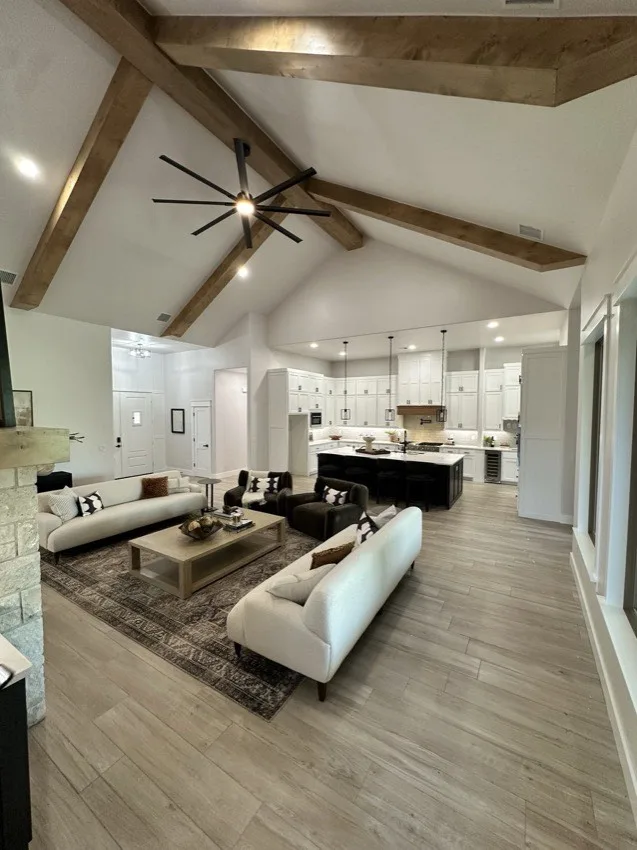
Modern black ceiling fan on a vaulted wood-beam ceiling in an Oklahoma City home
Overview

The box behind the fan is the whole job.

Every ceiling fan installation comes down to one question first: is the box in that ceiling built to hold a fan? A standard lighting outlet box is designed for a fixture that hangs still. A fan is a motor spinning a set of blades several feet across, which means it puts a moving, changing load on that box for hours at a stretch. Fan support requires a box that is listed and marked for it, anchored to framing or carried by a rated brace spanning the joists.

That's the detail most often skipped when a fan goes up in a hurry. The fan runs fine for a while, then starts to wobble, then the screws work loose - and the ceiling above it was never the right hardware to begin with. When we replace a fan, checking the existing box comes before anything else, and if it isn't marked for fan support we put in one that is.

The second half of the job is control. Most homeowners want the fan and the light on separate switches, and whether that's possible depends on what wiring already runs to the ceiling. Sometimes we can pull a second conductor and give you two wall switches. Sometimes a remote or a wall controller is the cleaner answer. Either way, we work that out with you before installation day rather than discovering it standing on a ladder.

Benefits

What a properly installed fan gives you.

1

A mount you never have to think about

A fan-rated box fastened to framing, or a brace spanning the joists, carries a moving load the way it's meant to be carried. No creeping wobble, no fasteners backing out over a summer of use, no wondering what's actually holding it up there.

2

The fan and the light on their own controls

Running the fan without the light on - or the light without the fan - is the difference between a fan you use and one you leave off. We wire separate switching where the wall allows it and set up a remote or wall controller where it doesn't.

3

Sloped and vaulted ceilings done right

Angled ceilings need a canopy rated for the pitch and a downrod long enough to clear the slope, mounted to framing that isn't running flat. Get the drop right and the fan actually moves air in the room instead of near the peak.

4

Less strain on the AC all summer

Moving air makes a room feel cooler than still air at the same temperature, which is what lets you nudge the thermostat up in July without noticing. In Oklahoma, that's the difference a fan makes in the rooms you actually occupy.

Signs you need this

When to have a fan looked at.

Some of these are installation requests and some are problems with a fan that's already up there. All of them are worth a call:

  • The fan wobbles, rattles, or clicks - especially on higher speeds
  • You can see the box or bracket moving in the ceiling when the fan runs
  • The room has a light fixture but no fan, and no idea whether the box will hold one
  • There's no ceiling fixture at all in the bedroom or living room you want a fan in
  • One switch controls the fan and the light together and you want them separated
  • The fan hums or buzzes, or the light flickers on a dimmer that shouldn't be there
  • Pull chains have broken off, or the remote was lost and never replaced
  • The ceiling is sloped or vaulted and the fan mounts crooked or hangs too high
  • An indoor fan is running on a covered patio and starting to corrode or warp
  • The blades sit low enough that someone tall has to duck
  • A fan was hung as part of a remodel and you're not sure what's behind the canopy

If a fan is visibly loose in the ceiling, stop running it and call us before it works itself further out.

Vaulted living room with wood beams and a black ceiling fan in an Oklahoma City home
Pricing guidance

What drives the cost of a ceiling fan install.

Swapping a fan where the box is already rated is a very different job from putting a fan where none has ever hung. Here's what actually moves the cost:

  • What's in the ceiling right now. If the existing box is fan rated, the install is straightforward. If it's a standard light box, it gets replaced with a rated box or a brace - easy from an accessible attic, harder from below through a finished ceiling. A brand-new location is more again, since it means running a circuit to the ceiling and adding a switch rather than swapping a fixture.
  • How you want it controlled. Reusing the existing switch is simplest. Adding a second switch leg for independent fan and light control means opening the wall or fishing a new conductor, and a remote or wall controller is a different path with its own cost.
  • Ceiling height, slope, and access. Eight-foot ceilings are quick, while two-story great rooms and stair landings need lifts or scaffolding no matter how simple the wiring is. Angled ceilings add slope-rated canopies, longer downrods, and a mount that has to land correctly on framing that isn't level.
  • Where the fan is going. Covered porches and other damp locations need damp- or wet-rated fans and exterior wiring methods, which is more than the indoor equivalent.
  • How many fans, and whether the ceiling needs patching. Several fans in one visit is more efficient per fan. Opening a finished ceiling to reach framing may mean drywall repair and paint afterward.

Your consultation is free, and you get a firm written price before we schedule - nothing added mid-job. We also partner with Wisetack for financing on approved credit. See financing details.

FAQ

Ceiling fan questions we hear most.

Can a ceiling fan hang from the light box that is already there?

Usually not. A standard lighting outlet box is built to hold a fixture that hangs still. A fan adds motion and vibration on top of its weight, so the box has to be listed and marked for ceiling fan support and fastened to framing or a rated brace. If the existing box is not marked for a fan, we replace it. That single detail is the most common thing skipped on a fan that was installed by someone else.

Can I control the fan and the light separately if there is only one switch?

Yes, and there are two ways to get there. If we can run a second conductor from the switch box to the fan, you get two wall switches - one for the motor and one for the light. If the wall cannot be opened easily, a fan with a remote or wall-mounted controller separates the two over the existing wiring instead. We tell you which one your wall actually allows before you choose.

Can a ceiling fan go on a sloped or vaulted ceiling?

Yes, with the right hardware. Sloped ceilings need a canopy or adapter rated for the angle and a downrod long enough to bring the blades clear of the slope, and the box still has to land solidly on framing that is running at an angle. On tall vaulted ceilings the downrod length also determines whether the fan actually moves air where you are sitting rather than up near the peak.

Why does my ceiling fan wobble?

Most wobble is either a mounting problem or a balance problem. Mounting comes first: a box that is not rated for a fan, loose fasteners, or a bracket that is not tight to framing will move no matter how well the blades are balanced. After that it is blade pitch, a bent blade iron, or an unbalanced blade set. We check the mount before touching the blades, because balancing a fan on a loose box only hides the real issue.

How much ceiling height do I need for a fan?

The blades need at least seven feet of clearance above the floor, so a standard eight-foot ceiling calls for a low-profile or flush-mount fan rather than a downrod. Higher ceilings do better with a downrod that brings the blades down into the room. We also want room around the fan - generally at least 18 inches from the blade tips to the nearest wall or sloped surface - so the air moves instead of stalling.

Can you install a fan on my covered porch or patio?

Yes, as long as the fan is rated for the location. A fan under a fully covered porch needs to be damp rated at minimum, and anywhere blowing rain can reach it needs a wet-rated fan. Indoor fans put outside corrode at the motor housing and the blades warp. We also check that the circuit feeding it is appropriate for an outdoor location while we are there.

Related services

Often paired with a fan install.

Ready to get some air moving?

Oklahoma summers put the air conditioner under load from June straight through September, and a ceiling fan in the rooms you actually sit in is the cheapest way to take some of that off. It's a small job with a short schedule - the ones that come out best are the ones booked before the first stretch of triple digits, not during it.

Call and talk to a real person, get a free consultation and a firm written price, and know that if anything isn't right after we leave, Grider always makes it right. Grider Electric is licensed and insured, based in north Oklahoma City, and works on homes and new construction only - serving Oklahoma City, Edmond, Arcadia, Guthrie, Yukon, Moore, Norman, Mustang, Piedmont, Bethany, The Village, Nichols Hills, and the Deer Creek area.

← All services