4.9 on Google (405) 242-3342 Request Service
Residential Electrical Service

EV charger installation for Oklahoma City homes.

A dedicated Level 2 circuit turns your garage into the only charging stop you need - full battery every morning, no public chargers, no waiting.

Homeowner plugging in an electric vehicle at a wall-mounted home EV charging station
Overview

What a Level 2 charger install involves.

Every electric vehicle can charge from an ordinary 120-volt wall outlet, and almost nobody is satisfied with it for long. That is Level 1 charging, and it adds range so slowly that a car driven a normal amount around the metro often cannot recover overnight. A Level 2 charger install puts the car on a dedicated 240-volt circuit instead - the same class of circuit as an electric range or dryer - and turns overnight charging into something you stop thinking about.

EV charger installation in Oklahoma City is mostly a question of two things: where you park, and what your electrical panel can support. A home EV charging station on the garage wall a few feet from the panel is a straightforward job. A charger at a detached garage, a carport, or the far end of a slab-on-grade house is a different project, and so is a home with a full panel or an older service. Both are very doable. They just should not be priced or promised as if they were the same.

We work on homes and new construction only, which means we spend our days in panels exactly like yours. We size the circuit to what your specific vehicle can actually accept, because paying for a larger circuit than the car will ever draw is money that buys you nothing.

Benefits

What changes once the charger is on the wall.

1

You stop planning your week around public chargers

No more routing errands past a charging stall, sitting in a parking lot, or discovering the one near your office is occupied or out of service. The car charges while you sleep and is full every morning, which is the whole promise of owning an EV in the first place.

2

A dedicated circuit means nothing else is fighting for it

Charging a car draws heavy current for hours at a time. Running that through a general-purpose garage receptacle shared with a freezer and a shop vac is how breakers trip mid-charge and how outlets and cords get hot. A properly sized dedicated circuit is built for a continuous load and nothing else lands on it.

3

You can shift charging to whenever power is cheapest

A Level 2 setup charges fast enough that you have room to schedule it. If you are on a time-of-use rate plan with your utility, you can put the whole session inside the off-peak window instead of charging around the clock just to keep up. We will help you set the schedule at the walkthrough.

4

It becomes part of the house, not a temporary setup

A permitted, hardwired station mounted on the wall with the cable managed is a finished piece of the home rather than a mobile connector draped over a hook with an adapter. It stays when you sell, it is on record as inspected work, and it looks like it belongs there.

Signs you need this

When it is time to call about a charger.

  • You have an EV or plug-in hybrid on order and want the circuit ready before delivery day rather than a month after.
  • You are charging on the standard garage outlet and the car still is not full in the morning, especially in winter when range drops.
  • The receptacle you charge from feels warm to the touch, the plug is discolored, or the breaker has tripped during a charging session. Stop using it and call.
  • A second EV joined the household and one slow outlet now has to serve two cars.
  • Your panel is full, or the home still has a smaller original service, and you want to know what is possible before you commit to a vehicle.
  • You park in a detached garage, a carport, or a driveway spot nowhere near the panel.
  • You are building, remodeling, or finishing a garage. Running conduit while walls are open costs a fraction of fishing it later.
  • You are relying on the mobile connector that came with the car plus an adapter, which was designed as a backup rather than an everyday solution.
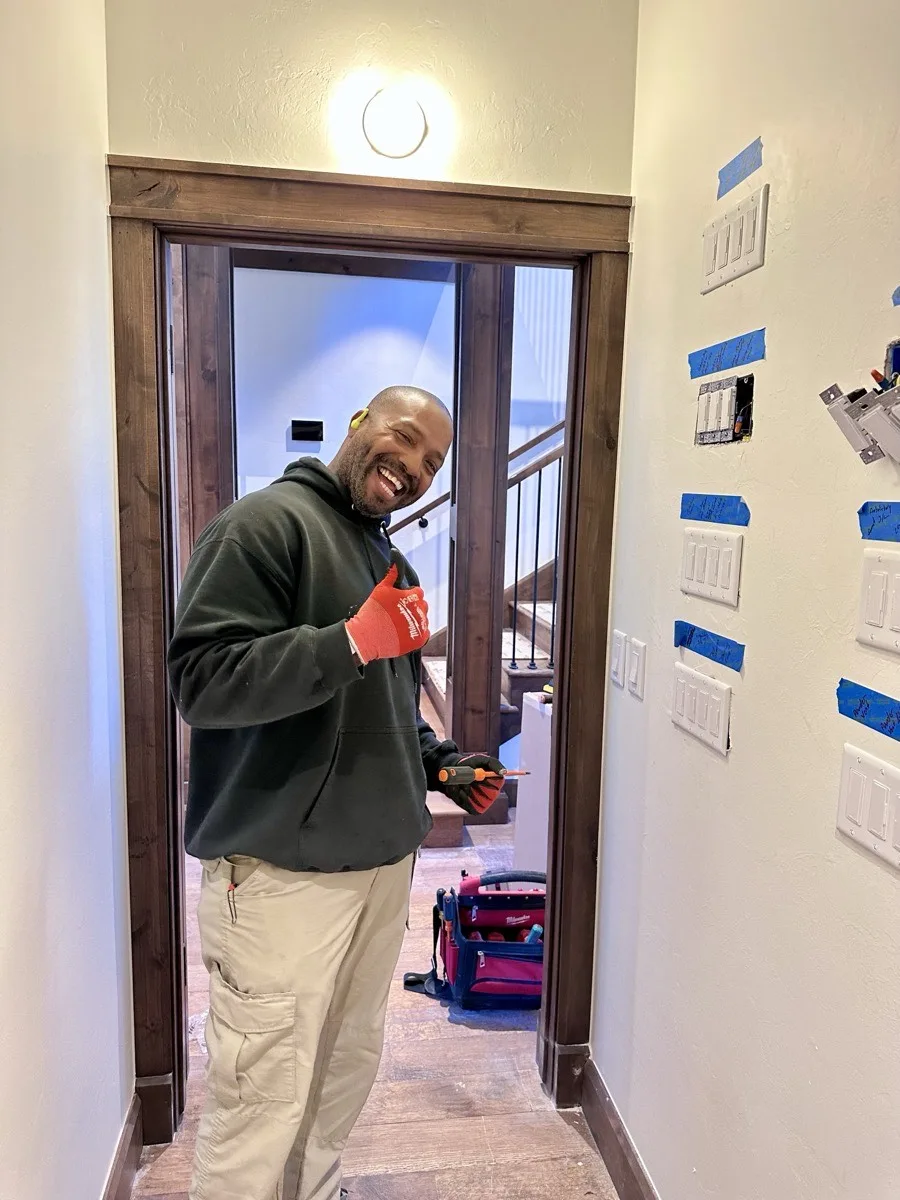
Ka'ron, journeyman electrician at Grider Electric, on a job in Arcadia, OK
Pricing guidance

What makes one charger install cost more than another.

Two neighbors can get very different prices for what sounds like the same job, and it is almost never about the charger itself.

  • The distance, the route, and where the charger lands. This is the single biggest factor. A panel on the garage wall is quick; crossing the house through finished drywall, working around a slab with no crawlspace, or reaching a detached garage adds conduit, labor, and sometimes trenching. Carports, driveways, and exterior walls also need weather-rated enclosures, outdoor-listed conduit, and proper sealing at every penetration.
  • Your panel's capacity and available space. A panel with room and headroom needs nothing extra. A full panel may need a subpanel or tandem arrangement, and a service that is genuinely maxed out points toward a panel upgrade or a listed load-management device that lets the charger share existing capacity.
  • Circuit amperage and how the charger connects. Larger conductors cost more per foot, and the difference compounds over a long run - matching the circuit to what your vehicle actually accepts, rather than to the charger's maximum, often saves real money with no practical downside. Receptacle installations also require GFCI protection, which changes the breaker involved; hardwiring avoids that but commits the unit to that location.
  • Who supplies the charger. Many vehicles ship with a capable unit, and plenty of homeowners buy their own. We are glad to install equipment you already have, which takes the hardware out of the project cost entirely.
  • Permit and inspection fees for your specific jurisdiction, which vary across the metro.

Incentive and rebate programs for home charging equipment change from year to year, so it is worth confirming what is currently available before you buy hardware. Your consultation is free and you approve a written plan first, and financing through Wisetack is available on approved credit - see our financing page.

FAQ

EV charging questions we hear most.

How long does it take to install a home EV charger?

A typical Level 2 install in an attached garage near the panel is a single-day job. It takes longer when the charger is going somewhere far from the panel, when the run crosses finished walls or a slab, or when the panel needs work first. We tell you which category your home falls into at the consultation, not on install day.

Do I have to upgrade my panel to install a Level 2 charger?

Not always. We start with a load calculation based on how your home actually uses power, not a worst-case assumption. Plenty of homes have room already. When capacity is tight, the options are a lower-amperage circuit matched to what your car accepts, a listed load-management device that pauses charging when the house is busy, or a panel upgrade. We lay out all three with the cost and tradeoff of each.

Should I get a hardwired charger or a 240-volt outlet?

Hardwiring is the cleaner and generally more robust option, it supports higher amperage, and it is required for some outdoor locations. A NEMA 14-50 receptacle lets you unplug the unit and take it with you if you move, and works well with the mobile connector many vehicles include. Receptacle installs need GFCI protection, which affects the breaker. Either is a good choice once you know how you want to use it.

Can you install a charger in a detached garage or carport?

Yes. A detached structure usually means running a feeder out to it, sometimes with a small subpanel, and often a trench if there is no usable existing path. Outdoor and carport locations use weather-rated enclosures, conduit, and equipment listed for outdoor use. It is more work than a garage wall next to the panel, and we will be straightforward with you about that.

Will you install a charger I bought myself?

Yes. Many homeowners already have a unit that came with the vehicle or was picked out to match it, and we install customer-supplied chargers from the major brands regularly. The equipment warranty stays with the manufacturer, and our work on the circuit, mounting, and terminations is covered by our own guarantee.

Does a home EV charger installation need a permit?

Yes. Adding a dedicated 240-volt circuit is permitted and inspected work in the Oklahoma City metro. We pull the permit and meet the inspector. Beyond keeping the install legal, a permitted circuit is what you want on record for your insurance and for whoever buys the house later.

Related services

Work that often comes with a charger.

Have the circuit ready before the car shows up.

The frustrating version of this project is discovering on delivery day that the panel needs work, the permit takes a week, or the incentive you were counting on expired last month. None of that is urgent if you start a few weeks ahead - all of it is urgent if you start the day the car arrives.

Call us, tell us what you are driving and where you park, and we will tell you honestly what your home needs. From the first call to the final walkthrough - Grider always makes it right. Grider Electric is licensed and insured, based in north Oklahoma City, and works on homes and new construction only - serving Oklahoma City, Edmond, Arcadia, Guthrie, Yukon, Moore, Norman, Mustang, Piedmont, Bethany, The Village, Nichols Hills, and the Deer Creek area.


← All services