4.9 on Google (405) 242-3342 Request Service
Residential Electrical Service

Whole-home surge protection for Oklahoma City homes.

One device at the service, protecting everything behind it - including the hardwired equipment no power strip has ever covered.

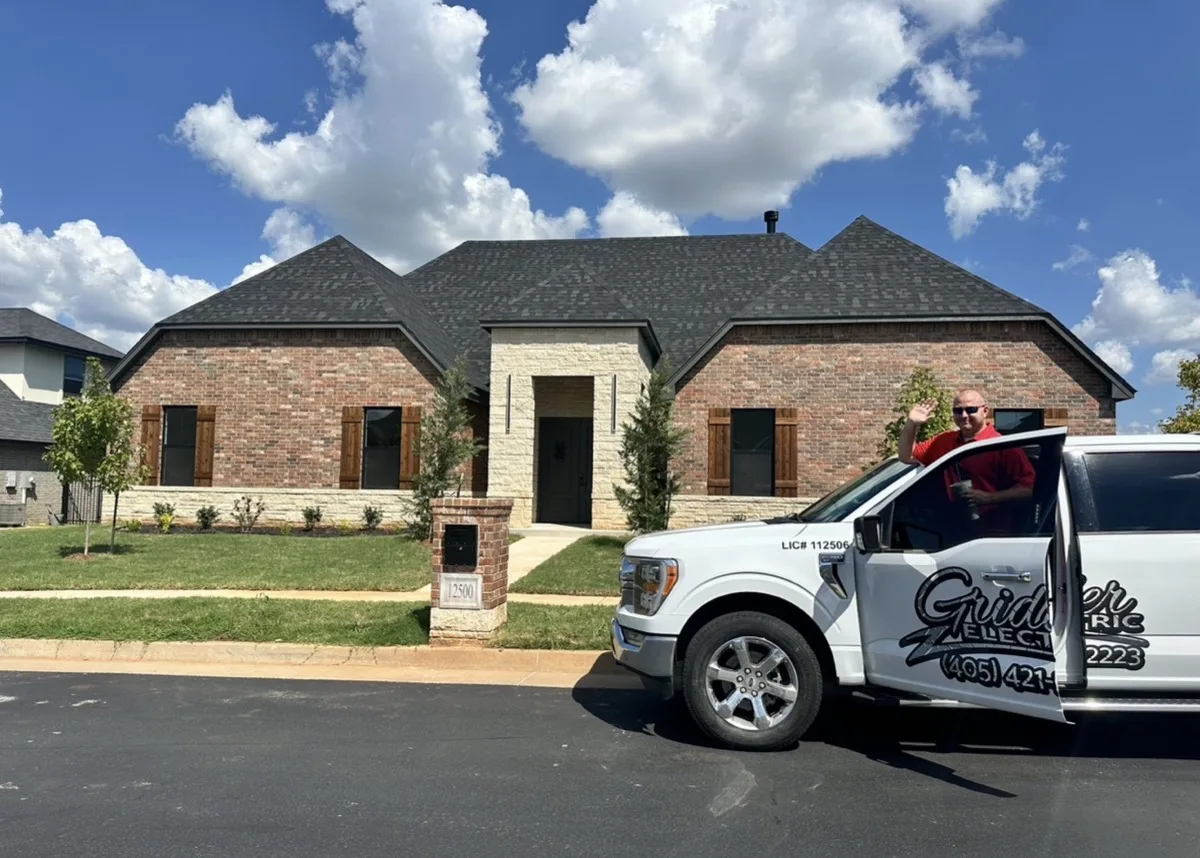
Grider Electric truck parked outside a brick Oklahoma City home with an electrician waving from the cab
Overview

Protection at the service, not at the outlet.

A whole-home surge protective device installs at your service equipment - mounted at the panel and landed on a two-pole breaker, or ahead of the panel at the meter - with the shortest, straightest connecting leads we can give it. When voltage on the incoming lines spikes above what your home's wiring and equipment are built to see, the device shunts that excess energy to ground in a fraction of a millisecond and lets what's left pass through at a level your equipment can survive.

Because it sits at the front of the system, everything downstream is behind it. That includes all the equipment that has no plug to protect in the first place: the air conditioner and furnace control boards, the range and the dishwasher, the tankless water heater, the well pump, the garage door opener, the sprinkler controller, every LED driver and dimmer in the house. A plug-in strip protects one outlet's worth of gear at a higher let-through voltage, and buying a dozen of them still leaves every hardwired load in the house completely exposed.

The threat is also less dramatic than most people picture. A direct lightning hit on the house is rare. What's common is energy arriving on the utility conductors - switching operations, capacitor banks, a pole hit by a car, the jolt when power is restored after an outage, or lightning striking a line a mile away and riding the same wires to your meter - plus the smaller spikes your own house generates every time a big motor kicks on. Most homes never take one catastrophic hit. They take thousands of small ones that quietly shorten the life of everything with a circuit board in it.

Benefits

What a device at the panel changes.

1

The hardwired equipment finally gets covered

The most expensive surge casualties in a house are usually the things you can't unplug. An HVAC control board, an oven's electronic panel, or a well pump controller is a real repair bill and a real wait for parts, and until there's a device at the service, none of them are protected at all.

2

Every circuit, including the ones you'd forget

Nobody puts a surge strip on the garage door opener, the doorbell transformer, the attic fan, or the dimmer in the hallway. Protection at the service doesn't require you to remember anything - if it's fed by the panel, it's behind the device.

3

It matches how much silicon is in a modern home

A house wired in 1990 had a handful of things that would notice a spike. Today there are LED drivers in every can light, boards in every appliance, a smart thermostat, cameras, network gear, and often a charger in the garage. The exposure went up; the protection at the panel didn't.

4

It's the right moment when the panel is already open

Surge protection is unusual among electrical work in that adding it to a job already underway - a panel upgrade, a generator, an EV charger - costs far less than sending a truck out for it by itself later. If we're in your panel anyway, this is the time to ask.

Signs you need this

Who should be adding one.

Surge protection is worth a conversation if any of this sounds like your home:

  • You have no device at the service at all - which is the case in most Oklahoma City homes built before it became common
  • You've already lost something unexplained: a modem, a thermostat, a garage door opener board, an appliance control board
  • Your lights blink or dim briefly when there's weather in the area, or you get short outages and quick restorations
  • Your home is fed by overhead lines rather than underground service
  • You're on the outer edge of the metro or on a rural feeder with long runs of exposed line
  • You're already scheduling a panel upgrade, a standby generator, or an EV charger install
  • The house is full of LED lighting, smart devices, cameras, or a home theater
  • You have a well pump, pool equipment, or an irrigation controller
  • There's an older surge device installed and its status indicator is dark or showing a fault
  • You have solar, a battery, or any equipment where an inverter is part of the system

If a storm has already taken out equipment and you're seeing tripping breakers, burning smells, or circuits that stopped working, that's a repair call before it's a surge conversation - shut the breaker off if you can do it safely and call us.

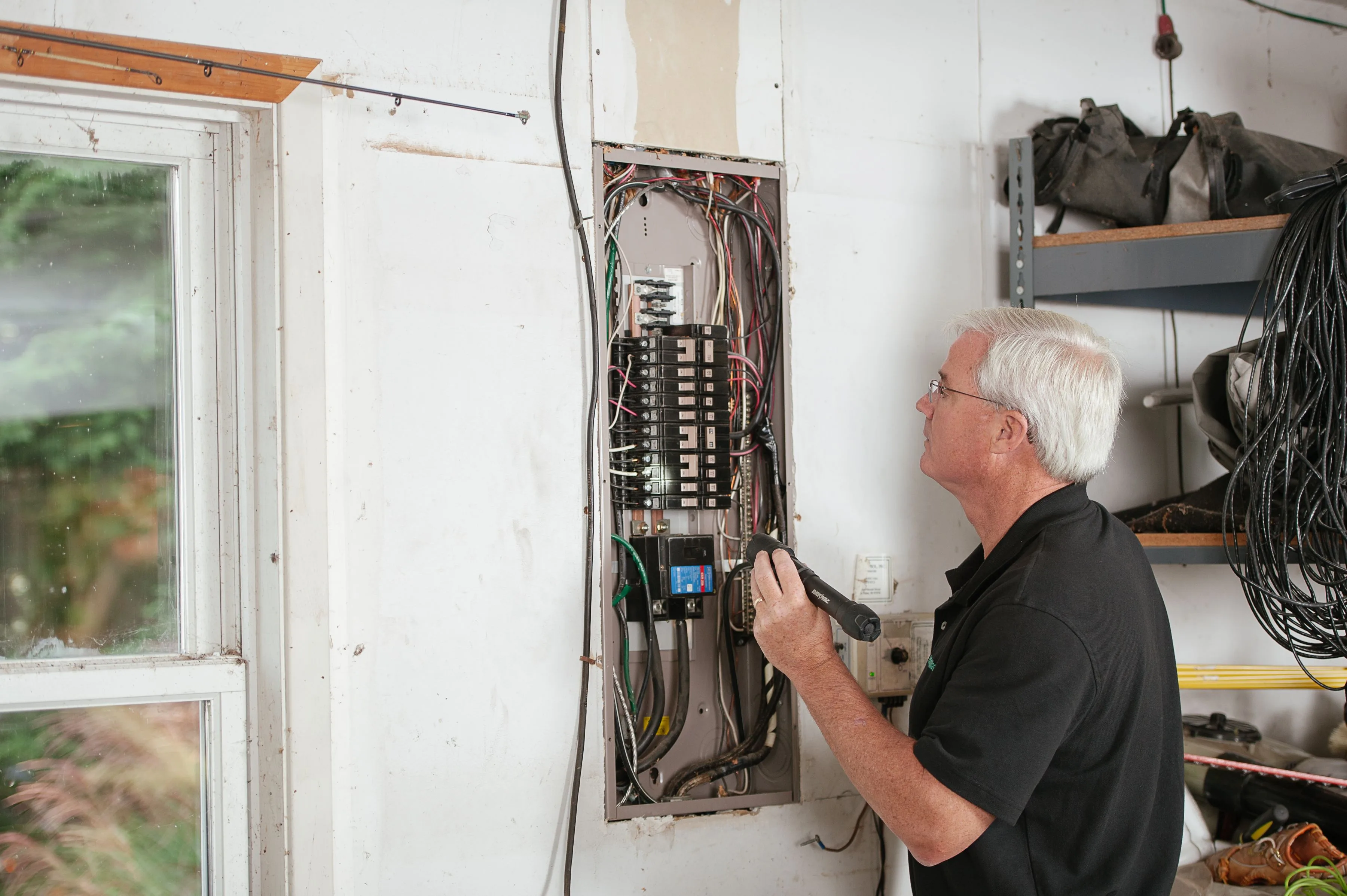
Electrician inspecting an open residential electrical panel with a flashlight
Pricing guidance

What drives the cost of surge protection.

This is one of the smaller electrical projects a homeowner takes on, but a few things genuinely move the cost:

  • The device itself, and how many layers you want. Surge current capacity, the let-through voltage it clamps to, whether it's built for the line side or the load side, and the length and terms of the manufacturer's warranty all separate a basic unit from a serious one. Adding point-of-use protectors at the theater, the office, or the network rack is optional and priced separately from the device at the service.
  • Where it mounts, and what else is happening that day. A panel-mounted device with an open double space is straightforward; a meter-mounted unit ahead of the service, or a panel with no room left, is a different scope. Bundled into a panel upgrade, a generator install, or an EV charger job, the labor is a fraction of a standalone visit.
  • The condition of what's already there. Obsolete or discontinued panels don't always have listed breakers still available for them, and mounting new equipment in a panel with existing problems isn't something we'll do without addressing them first. The device is also only as good as the path to earth behind it, so older homes sometimes need ground rods, water-line bonding, or a corrected electrode system before the protection means anything.
  • Permit and inspection requirements. These vary by municipality across the metro, and we handle them where they apply.

Your consultation is free, and you get a firm price in writing before we schedule. We also partner with Wisetack for financing on approved credit. See financing details.

FAQ

Surge protection questions we hear most.

Will a whole-home surge protector stop a direct lightning strike?

No, and anyone who tells you otherwise is overselling. A direct strike on the structure carries far more energy than any residential device is built to absorb. What a whole-home device is built for is the surge that arrives on the utility conductors - including lightning that hits a line somewhere down the road and travels to your meter - and the spikes generated inside your own house. Those account for the overwhelming majority of surge damage we see.

If I have a whole-home device, do I still need power strips?

For sensitive electronics, yes. The panel-mounted device knocks a surge down to a level the house can live with, and a good point-of-use protector at the TV, the computer, or the network gear handles what is left. They are two layers of the same system, not competing options.

How do I know it is still working?

Whole-home devices have status indicators, and we show you exactly what yours looks like when it is healthy before we leave. The internal components wear down as they absorb surges, so a device that has taken a hard hit or many years of small ones eventually stops protecting and tells you so. Glancing at it after a bad storm season takes five seconds.

Does it need to go in the panel, or can it be somewhere else?

It has to be at the service. Depending on your setup, that means mounted at the panel and landed on a two-pole breaker, or mounted ahead of the panel at the meter. Either way, the connecting leads are kept as short and straight as possible, because extra wire length directly reduces how well the device performs.

Do I need a panel upgrade before I can add surge protection?

Not usually, but sometimes. The device needs a safe panel with space available and a sound grounding and bonding system behind it, because the surge has to have somewhere to go. If your panel is an obsolete brand, is full, or has grounding problems, we will tell you that first rather than mounting a device on top of an issue.

How long does the installation take and will my power be off?

On its own it is typically a short visit, with the power off only for the portion where we are working inside the panel. We tell you the expected window beforehand. If it is being added during a panel upgrade, a generator install, or an EV charger install, it usually adds very little time to that job.

Related services

Often paired with surge protection.

Get it installed before the next storm, not after.

Surge protection is the one thing on this site that's worthless the day after you needed it. Oklahoma runs a long severe-weather calendar - spring storms, summer heat and grid switching, winter ice - and the calls we get about fried control boards always come in right behind an event, when the only options left are repair and replacement.

Call and talk to a real person, get a free consultation and a firm written price, and know that if anything isn't right after we leave, Grider always makes it right. Grider Electric is licensed and insured, based in north Oklahoma City, and works on homes and new construction only - serving Oklahoma City, Edmond, Arcadia, Guthrie, Yukon, Moore, Norman, Mustang, Piedmont, Bethany, The Village, Nichols Hills, and the Deer Creek area.

← All services